Common Name: North American/ European/Vancouver Island Wolverine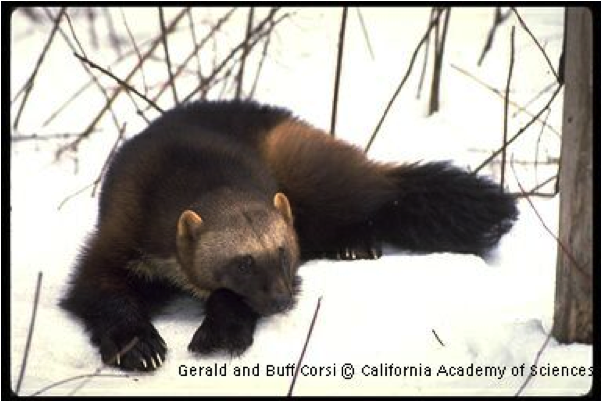
Scientific Name: Gulo gulo sp.
Gulo gulo luscus (North American)
Gulo gulo gulo (European)
Gulo gulo vancouverensis (a possible Vancouver Island sub-species)
IUCN classification: Near Threatened
Size:
Height: 36-45 cm
Length: 65-105 cm
Tail: 13-26 cm
Weight: 9-30 kg (20-66 lbs)
Range: Northern Europe, Asia, North America (boreal zone)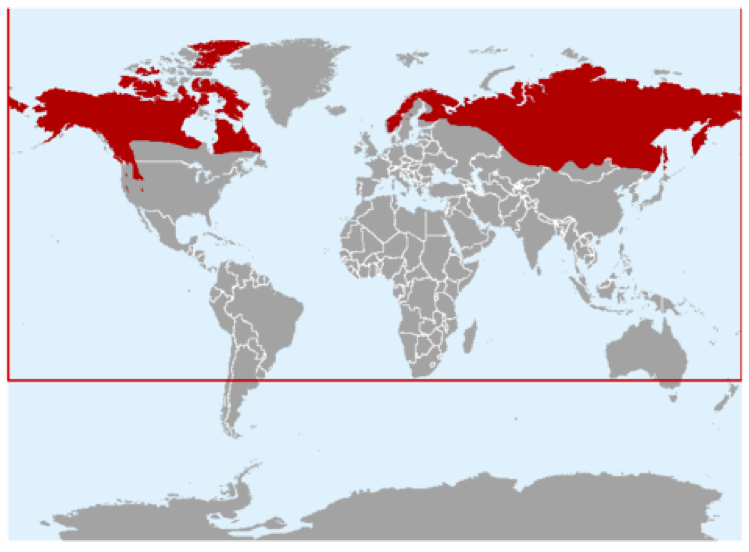
General Information:
Wolverines are known as solitary, aggressive and territorial animals and are one of the largest members of the mustelidae or weasel family, which includes skunks, martins, and ferrets. They are also known for great courage, with individuals known to chase bear, cougar, and wolves from carcasses. Their ability to travel long distances and maintain high rate of speed for approximately 10 miles (16 km), explains why home ranges are so large. With the wolverines range being mainly in the high northern hemisphere these usually nocturnal animals will often experience 24 hour day or night. During these periods their time is spent with four hours of rest followed by four hours of activity (Patsy et al. 2009).
Wolverines are commonly known as scavengers of the kills of other predators such as wolves, cougar, or lynx. Much of their usual hunting prey consists of wild sheep and small mammals, including rodents and lagomorphs. In the winter season Wolverines have been known to hunt larger prey such as deer and moose due to the inability of the prey to maneuver well in deep snow (Abramov 2009).
The mating season of the wolverine is during the summer months, but unusual in this process is the 6-7 month period between insemination and implantation. Implantation occurs in the winter months and kits are born between February and April depending on region. Authorities in this area have not come to a solid conclusion as to the birthing time of the wolverine but kits emerge from under snow dens in April and May (Rausch 1972). Wolverines become sexual mature at approximately 2.5 years old (Whitman 1999).
Habitat:
Wolverines live mainly in boreal forests in the northern hemisphere with their range spreading south through western North America through to California. Historic ranges covered much more of the southern regions of Europe, Russia, and North America. Due to hunting and population fragmentation, as well as habitat destruction they have been limited to more remote regions (Abramov 2009).
Wolverines are territorial with females maintaining smaller ranges than males, territories vary between 100 km2 and 600 km2 (Whitman 1999). Density of these animals ranges between 1 per 500 km2 in northerly regions and 1 per 65 km2 in southern regions within the United States (Abramov 2009).
Climate Change:
The Wolverine has a deep connection with the snow causing it to be one to the organisms which will show the effects of climate change. This connection is seen through its scavenging of carcasses which are more easily stored in the cold of winter, as well as in its increase ability to catch and take down prey items in the snow (Abramov 2009). As the snow line creeps higher up the mountains and further north wolverines will be left limited in their hunting ability as well as their scavenging ability. Scavenged carcasses in a warmer climate will decompose at a higher rate decreasing the availability of scavenged food. Also the ability of the wolverine to hunt large prey will become non-existent.
Due to high population fragmentation within the southern ranges and the locality these populations will be the hardest and first hit by climate change with the potential extirpation of these species from these southern regions. The wolverine has already undergone massive habitat destruction and fragmentation and with the impending climate change will surely show massive decrease in range over the next century.

