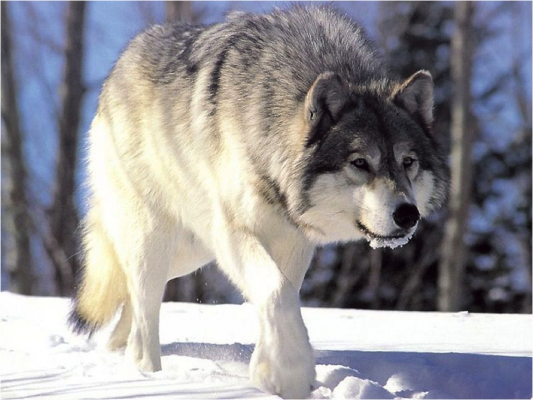
 Common Name: Grey wolf, Timber wolf, Mexican wolf, wolf, Arctic wolf, Tundra wolf
Scientific Name: Canis lupus
IUCN classification: least concern
Size:
Height: 61-94 cm
Length: 131-201 cm
Weight: 25-86 kg (55-190 lbs)
Range: Canada, Alaska, northern United States, Europe, Asia between 75oN and 12oN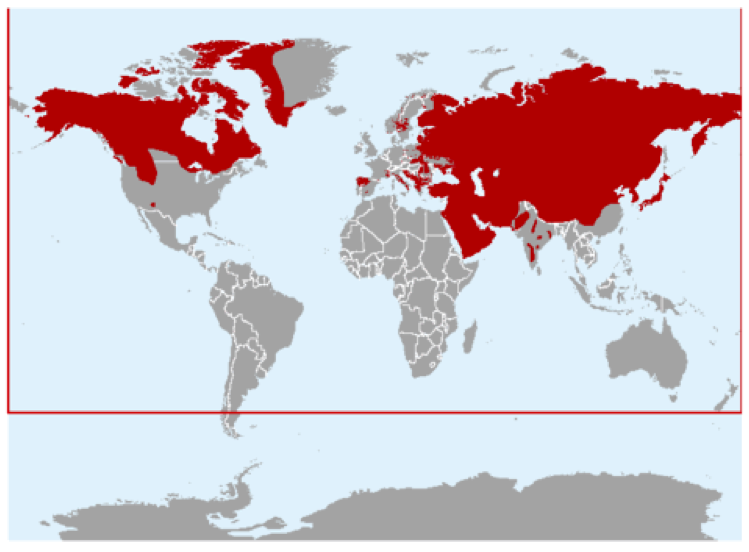
General Information:
The grey wolf lives in remote forest habitats in packs varying in number of individuals. These packs are often made up of a family unit with males leaving the pack near sexual maturity. Only the alpha or dominant male and female of each pack reproduces and all members of the pack help to look after the young. The pack hunts cooperatively, allowing them to take down larger prey than they would as individuals (Mech & Boitani 2008).
Habitat:
The grey wolf was once the worlds’ most widely distributed mammal, until over hunting and habitat destruction pushed their populations out of much of their southern range. Currently the grey wolf is found in remote, forested regions with pack sizes and population sizes varying with region.
Climate Change:
With wolves being so versatile in habitat and prey type it leaves the question of how they will be affected by climate change. Wolves have proven that in regions with greater snow fall pack sizes will increase during the winter months, making the pack more efficient hunters. In the case of global warming, limitations on the amount of snow pack during the winter months will cause these packs to remain at smaller sizes. This variation will show drastically different effects on the ecosystem and the trophic food chain within the wolf’s habitat (Post et al. 1999). In the southern populations limited to no snowfall will cause the abundance of prey organisms to increase. This will have varying affects on the vegetative ecosystem of the area.
One example of this is with the Isle Royal population, which has been well studied for many generations. These wolves prey upon mainly moose in the winter months and with increase in snowfall there is a tripling in the rate of moose take-down. This stops the moose from eating the vegetation and therefore the vegetation in the area benefits. With wolf packs remaining small the moose population will increase and the vegetation will show a decrease due to over browsing (Post et al. 1999).
Another similar impact of wolf populations on ecosystems undergoing climate change has been studied in Yellowstone National Park. There the extirpation and reintroduction of wolves has given scientists the ability to view the impact of the wolf population on the ecosystem. With wolves as one of the top predators in Yellowstone they cause effects on the entire trophic cascade. It is believed that wolves act as a buffer to climate change through their contribution of carcasses and population control. For lower level predators and scavengers winter without wolves meant little to no food was available but with wolves they can survive. In the reintroduction of wolves to the Park, balance has been seen between predators, scavengers and prey. This balance will allow these organisms to feel the effects of climate change to a lesser degree (Wilmers & Getz 2005).

