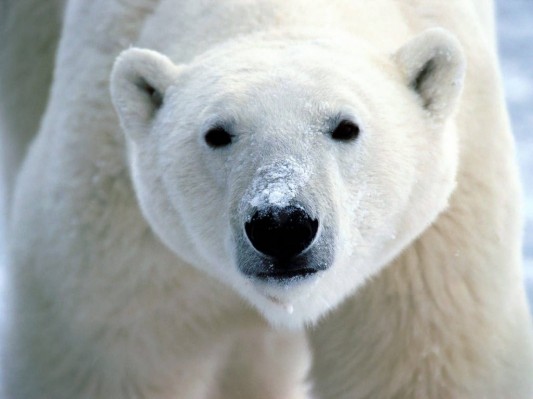
 General Facts
Conservational Status: Vulnerable
Scientific Name : Ursus maritimus
Weight: Males – 350-680 kg Females – 150 350 kg
Range: Arctic Circle, Beafort Sea, South Hudson Bay, East Baffin Island, West Greenland, Berents Sea, Kara Sea, Chukcki Sea, Denmark, Norway, and Russia.
Prey: Ringed Seals, Bearded Seals, Fur Seals, Walrus, Carrion,
Hunting: 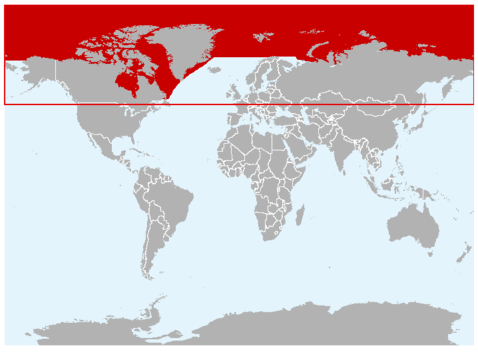
Proof of bears digging through 41 cm of rafted ice to reach the seals. Rafted ice is ice that had formed layers with air pockets between layers. This allows seals to surface under the ice and be protected from predation by polar bears. Bears are also starting to cannibalze other bears in response to nutrition stress. During the ice-free season (August to October), some bears in Hudsons Bay were found to be comsuming berries such as Bog bilberry(Vaccinium uliginosum) and Crowberry (Empertrum nigrum). This foraging behaviour is most commonly seen in females and sub-adults
Climate Change:
The polar bear relies heavily on the sea ice to hunt and capture their prey. Seals fish near continental shelves and bears use sea-ice to get out to the place where the seals are. Without ice the bears cannot hunt their primary food source. While bears are on land they fast, without the ice returning quickly enough many bears could die of starvation. As food is harder to find more bears near communities will become “problem-animals.”
In a lecture given by Karen Hodges some of the impacts of climate change on the polar bears were outlined. The polar bears that make up the most southern populations will be the first to feel the change in climate. This most southern population of bears is found in James bay, Hudson bay, and Labrador. Another factor affecting the bears is that their denning sites are shifting towards land. These new land sites may not be as high quality as the preferred ice dens. Mothers will have to travel farther between denning sites and feeding sites. Also an increased amount of rain on the surface may cause the den to collapse, often killing the mother and cubs inside.
Evolution
There are approximately 20,000 – 25,000 polar bears. The North American Polar bear population represents 70% of the total Polar bear populations. The genetic differences between the bears are small because there is reduced geographic overlap within the wild populations. Breeding occurs in the spring and cubs are born during late November to mid January. Female polar bears use snow dens to give birth and raise their young therefore, having snow and ice is very important for these bears. Polar bears are able to reproduce around age 5 or 6 and have a low fecundity rate.
A study showed that some bears have been changing in size and shape over time. As the bears become more stressed in an effort to find food the energy requirements of a large body mass is not beneficial. Also polar bear’s suffer from a great deal of pollution; it is thought that between the pollution and reduced food resources there seemed to be a trend in reduced size.

